


Some of our International readers are very surprised by these stories. They are all true; and we do our best to fact-check them. It's just trivial for tenants in Spain to live in someone else's property, for years, without paying or facing any serious repercussion. This is the theme for this web page, but it's just one of the arms of a bigger housing problem, on a trend that has been reinforced by both the ineptitude of lawmakers and the extremely congested judicial system. In fact, it's so easy and widespread, that the phenomenon has a name: ‘inquiokupación’.
An ‘inquiokupa’ may not be a term used in legalese, but it is used to describe that: squatters with a contract.
The Spanish government came with a plan to solve the housing crisis. While always distrusting any politician's motivation, we still had a glimmer of hope that their decisions would show some competence.
That hope quickly faded. No matter how much Sánchez works on an image of a resolute and competent politician, the decisions taken by his government show otherwise.
And the decisions taken were about doubling down in the same mistakes that deeply worsened the situation within the last decade.
But let's tax the British! That will solve everything! No. The British represent merely a 1,5% of the real estate trade in Spain (give or take, depending on the year). This smells, simply, like a red herring. The numbers don't justify it. This is not Vancouver in 2016, where it made sense. Trying to make it steeper by taxing the British won't solve the problem. As with the tourist apartments, it's all more about the optics than the numbers. And about blaming, pointing fingers to evade responsibility.
And why not, let's keep promising public housing development while ignoring the meager delivery on this exact promise in these last years. And let's forget about providing a safe judicial system to avoid squatters and inquiokupas... this surely doesn't affect those crazy rental prices! /s
It's all about the British! The blame is on the British!
Small owners are the main victims of ‘inquiokupación’. Their mental and financial health is at stake. Large property holders and ‘vulture funds’ —while still being affected by the problem— can handle the damage much better; they are more used to lawyer up and fight in the muds of the ‘inquiokupas’. The damage they end up suffering is usually a numbers' game, one that rarely creeps up into their mental health.
That being said, the Spanish Government should protect all owners from this problem. Yet it's inevitable to become more irate by witnessing the enduring abuse of small owners. To feel more empathy for them.
And so, this empathy leads us to appreciate another level of social injustice: Spanish politicians, those connected leeches... they will never face the personal damages of ‘inquiokupación’. Why not? Because for them, the whole process would last a couple months —not years. Also because the professional ‘inquiokupa’, like all the bullies, feeds on the weak, the ones left unprotected and ignored by the system. How idiotic would be for an ‘inquiokupa’ to squat a civil judge's property? As idiotic as squatting a politician's property.
Yes, Spain is the country where a friend can cut you in line when dealing with the Government. Where this is completely normalized. Thanks to that friend, your appointment is tomorrow, rather than in two months! An appointment for whatever simple thing you had to deal with the Social Security administration.
If having contacts works so greatly at lower levels, we can easily infer how the game is played when people have real political power of any kind. It becomes quite evident that a politician will easily get fast track access to justice in Spain.
And we repeat again: justice delayed is justice denied. Thus, we can assert that in Spain, justice is denied to people with no influence.
There are, without a doubt, Spanish politicians that rent out their properties. Many, probably. Do they care about ‘inquiokupación’? Not at all. The legal uncertainty doesn't affect them. Because they have a shortcut to justice.
With the pathetic situation of Spain regarding both the owners' and tenants' rights, a myriad companies have spawned, willing to help with (or feed on) the desperation of many.
Such is the case of renter's nonpayment insurance companies, in many different forms, and offering different degrees of involvement in the rental process. Or of specialized debt collectors. And, of course, we're leaving the most prevalent for the last: companies that are supposed to do what law enforcement should; to kick the squatters out. A type of company that wouldn't exist if the problem wasn't so dire.
These companies are making a fortune.
However, we are very skeptic about them. Morals and ideologies aside, most are quite ineffectual, specially considering the cases in which there's a contract signed (that is, ‘inquiokupación’ vs ‘okupación’).
And when it comes to ‘inquiokupación’, these companies are nothing but a bunch of muscular guys that would do their theatrics to scare the ‘inquiokupas’ away. Something that rarely works. Someone that can leech of a landlord like an ‘inquiokupa’ is hardly dissuaded with theatrics.
An effective technique that was sometimes used by these companies was the ‘control de acceso’, wherein the company —acting as a security firm— would establish a checkpoint at the entrance to the property and deny access to the ‘inquiokupas’.
This technique has been fought back by law enforcement in many areas, effectually disabling the only real tool these companies had against the ‘inquiokupas’. In our opinion, that would be fair, if the rest of the system worked (justice and law enforcement regarding evictions).
With the current state of the law, they can't really do anything but to mediate, and offer money to the squatters. They may be useful if the owner can't handle directly the ‘inquiokupas’; something really common, as these situations end up —after years of dealing with them— being very anxiety-inducing.
Still, many of these companies show their dishonesty by overpromising and portraying false rates of success. They take the money (thousands of euros) from the customer, and then —after making sure the money is deep in their pockets— justify their lack of activity and inability to take effectual measures by blaming the laws.
Not all companies in this novel sector are like this. Yet the dishonest companies within the ‘desokupación’ market are scammers. Very much so. And not much better than the ‘inquiokupas’ themselves.
These companies should have no reason to exist. If law and justice worked properly in Spain, they wouldn't exist.
Then again, none of these things would have happened without the incompetence and greed of Spanish lawmakers.
Let's hope the three wise men bring a solution to this! (yeah, hopes are being reduced to a fantasy, in this respect)
Not long ago, every single lawyer would have advised you to never take the law into your own hands when dealing with inquiokupas. There is a trend against this; more and more, the suggestion to kick the squatters out is brought up, always with the caveat of not being "officially given" advice.
This is not a symptom of an increase of sleazy lawyers. Rather, it is a symptom of a situation that is so dire that it's often better for the landlord/landlady to expose himself/herself to an accusation of criminal coercion than to deal with the losses of money, health, and time required to legally evict inquiokupas in Spain.
Thus, we have to agree with the lawyer Bárbara Royo, who stated in the TV show "En boca the todos" that, if she was suffering from inquiokupación, she would force the squatters out, replace the locks, and face whatever consequences that might bring.
We agree with her because when justice is so slow and fails so badly as it does in Spain, there's nothing left to do than taking the matters into your own hands. It's really appaling. Who really considers normal that tenants can be more than two years without paying any rent and face little to no consequences?
The ‘inquiokupa’ —one of the two people responsible for more than two years of anxiety, anguish, and my exile from Madrid— is an agent working for a nationwide real estate agency in Spain.
She has good and bad reviews (the positive one is from a friend, we suspect):
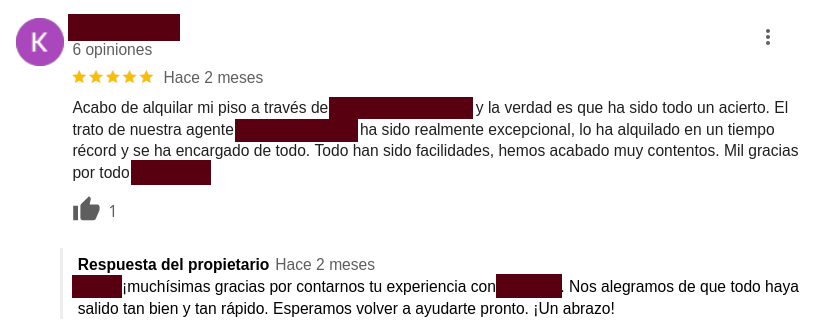
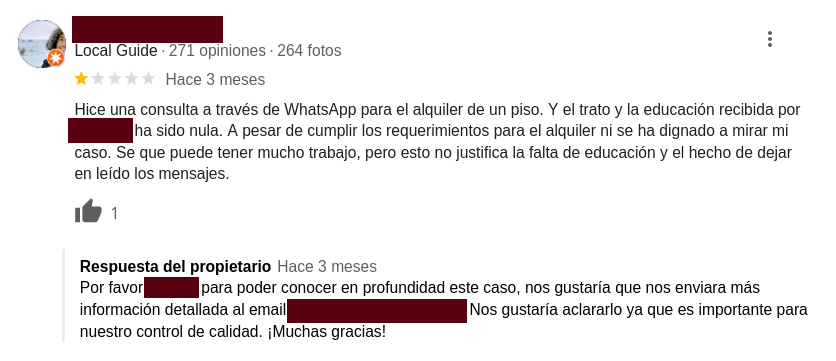
It was a fact that we knew since long, though we thought she focused more on sales. Now that it's more clear that she does rental too, it becomes quite interesting, coming from a tenant who has not paid rent for over two years.
The company for which she works certainly knows that she's been delinquent for years: the person that mediated the rental that they aren't paying, a colleague in her profession, contacted the company to inform them at one point. It was over a year ago, when they had already been unpaid for more than a year. He explained to the company his employee's situation, and all he received from that real estate agency were threats of lawsuit. Naturally, the mediator did not want any trouble, so he dropped it.
It all began when this couple was looking for an apartment in Madrid. The apartment, of a certain luxury, with three bedrooms and 150 square meters, was probably excessive for only two people.
But her husband, a Frenchman, showed that he had won approximately 150,000 euros the previous year, showing a copy of the French tax return. It would have to be seen if there was no falsification of documents; or if not, where they threw or hid that money. She had an apartment in ownership. With the documentation provided, they made people think that they were not going to create the big problem they have created.
They claimed to come from Cantabria, where we imagine they must have left a similar swindle behind.
The same story that happens in many cases of ‘inquiokupación’ occurred: after paying less than a year in, they just stopped paying. Making many promises: "it will be solved", "a big payment is coming." We spoke with them, offering to forgive the months' debt they owed if they left.
Obviously, they refused to leave. Since they knew very well that they could live for free for several years, why would they go?
He directly said: "denounce us, I won't fight it." Technically, that's true; because she was the one who appealed and is still using every kind of trick to drag out the ordeal.
Her appeal, utterly absurd, was merely meant to prolong the process. An additional year free of charge, at least!
Logically, the judge dismissed the appeal and convicted them, including costs, after a trial that they didn't even attend.
Well, they are not particularly intelligent. You don't have to be: taking advantage of the slowness of the Spanish legal system is simple.
Each legal step to be taken by the renter, of the many steps need to be taken until eviction, takes months of waiting.
At least, they are not physically violent. Except for occasional veiled threats, a call to the police about noise, and causing general discomfort among neighbors, they keep a low profile. However, it is very annoying to see her become irate and slam doors when asked to leave: as if it was her right to continue living rent-free in a luxury apartment after more than two years without paying. Well, maybe she grew up in a home without consequences, where the blame is always on others.
As of today, with 28 months unpaid and a debt that has already reached €50,000, with the eviction order already signed by the judge, we are still waiting for an eviction date. Although they have fewer options left, knowing them, it wouldn't be surprising if they had more of their tricks to get another year's worth of free rent.
They probably will try again to be declared ‘vulnerable’, a legal status that would allow them to extend this further. This would explain why he goes in a wheelchair even though he is seen walking when they think he doesn't see them, malingering. The last time they tried to be considered ‘vulnerable’, they didn't even open the door for the social worker.
In the legal framework existing in Spain, considering the timeframes of justice, it is no surprise that there are such cases. Cases of people clearly exploiting the system and taking advantage of others. And it is also not surprising that renters resort to companies to force the ‘inquiokupas’ out, and even to take justice into their own hands.
As for us, we want to believe in justice. That's a hard task in Spain.
Yet there they are, still living for free in a three-bedroom apartment and going out to play padel.
They will never leave the squatted apartment willingly.
They will probably leave the day before the eviction. We'll see. That, if we live long enough to see the day.
Well, at least she hasn't stopped working. Nor stealing.
Okay, okay. The term ‘inquiokupa’ does not have legal meaning. They are ‘inquilinos morosos’ in the eyes of the Spanish law. Still, the same could be said for 'okupas', which would be ‘usurpadores’. Maybe ‘allanadores’.
Regardless, we believe that ‘inquiokupa’ conveys much more than ‘inquilino moroso’. Both terms overlap but also do not evoke exactly the same meaning. That is, their connotations are very different.
In our opinion, there are many shades of gray in between. Many people are in precarious situations who have no other choice but to be behind on several months of payments. We do believe that landlords should be relatively understanding with delinquency cases; though, just in case, we always recommend starting the judicial process as soon as possible.
Beyond that precariousness, there is the profile of the ‘inquiokupa’, who:
The profile of the ‘inquiokupa’ is changing as of late. Before, they showed more recognizable patterns:
In summary, we believe that if they owe more than six months of unpaid rent, they still refuse to leave, and they cut off all communication with the landlord, they can already be considered ‘inquiokupas’.
To be an ‘inquiokupa’ in Spain is easy, and it comes at almost no cost nor risk! Even after falsifying of documents, even after presenting baseless claims to prolong the eternal legal proceedings, most landlords will not dare to go through a criminal lawsuit. People generally don't want any trouble. It won't get beyond the civil law. And if they dare to start a criminal cause, the defrauded will have a very tough time proving any fraud.
In Spain and especially in the real estate sector, mainly for small landlords, there is practically no legal security. This is fundamentally due to the ‘collapse’ of justice, but also due to recent legislation changes.
The slowness of the courts varies by area, but the current minimums for evicting ‘inquiokupas’ is around one year. And that's the best case scenario. Three years is already quite common. If the tenants are considered ‘vulnerable’ (which is quite easy), it can reach five or more years.
Somebody without any moral principles may say that “paying rent in Spain is for idiots”. And indeed, it seems so, considering that most small landlords will follow legal paths and that a squatter has all kinds of tools at their disposal to enjoy years of free rent.
In these conditions, the real estate rental market will end up being reduced to vulture landlords (in the end, the only ones with the ability to withstand and defend themselves in such a broken legal panorama), and exploited tenants, or those rejected by the environment of fear. Fear that has been generated by the normalization of ‘inquiokupación’.
And so, with even fewer homes on the market, rental prices will continue to rise, even more so. Of course, ‘desokupación’ and ‘safe rental’ businesses will keep making fortunes.
Meanwhile, politicians will keep making promises...
The new express trial law establishes expedited trials concerning cases of usurpation and trespassing (‘usurpación’ and ‘allanamiento de morada’). Two-week deadlines from the complaint to the trial.
This sounds very good, but in practice it does not seem that much is going to change:
The great problem of slowness in justice in Spain will not be solved magically by this law. Though we hope it would open the path to a solution of the problem concerning squatting... at first glance, it seems that little is going to change.
Of course, this law will not affect, in any way, cases of ‘inquiokupación’; of tenants that don't pay and refuse to move out. These go through civil courts, not criminal courts; regardless how fraudulent many are.
Thus, if someone wants to solve their problem of ‘inquiokupación’ through the legal route, they will still have to face two years of hardship. Or more.
Links and references are typically in Spanish. After all, this is a chronicle of a Spanish problem.
It is often forgotten that the great damage caused by squatters is not merely economic.
Even in the case of landlords with the capacity to absorb the economic blow of years of ‘inquiokupación’, the harmful effects on the landlord's mental health should not be overlooked; nor the physical consequences that these produce.
There is no need to spend much time searching to see cases of ‘inquiokupación’ describing anxiety disorders and their consequences:
...and many more, like the case of (yet another) Mari Carmen, where she's being threatened with violence:
That's three distinct Mari Carmens. One would say that if your name is named Maria Carmen, you'd better not become a landlady. Yet the truth is that the problem is so widespread that it's easy to find recent cases affecting any common name.
A fourth Mari Carmen:
Well, things aren't going well.
A related comment:
The political slant of different media sources is glaringly obvious when reviewing coverage of 'inquioukupación' cases. It's infuriating to observe certain political parties and their affiliated press dismissing the injustices chronicled in numerous news stories, allowing only opposing media outlets to monopolize the narrative.
Media outlets that deny a patent problem and belittle the affected parties lose credibility. And those affected, the victims, radicalize. The politicization of the issue of ‘inquiokupación’ (and the even greater parent problem of housing) is yet another example (one of many) of increasing polarization; of the constant political manipulation that does not seek to solve problems but to acquire political power by blaming the other ‘tribe’. This trend is becoming unsustainable; it generates extreme mistrust, both toward politics and the media. The media should be much more neutral, but that's chimerical.
In our case, we try to keep politics aside, even considering that this blog is extremely thematic; and that the theme is too politicized.
The popularity of the case of Antonio Canales, who is now known to be an ‘inquiokupa’, may annoy some other victims of ‘inquiokupación’: after all, his debt barely amounts to €5,000. And most of it is for utilities!
But, despite the fact that the case itself will likely be resolved by media pressure, it should not be minimized: because it once again exposes the growing problem of ‘inquiokupación’.
His landlady, had she not turned to the media to bring attention to her problem, would face years of waiting and the frustration of a collapsed judicial system. “Justice delayed is justice denied.” By turning to the media, she not only brings visibility to the issue but, undoubtedly, will achieve a faster resolution as well.
The real problem is that most landlords who are in debt do not have the option to expose their tenant to the public opinion. In fact, many landlords must instead justify their situation, explain that they are not exploiting vultures, justify that they are the victims. In Spain, it has been normalized for scrutiny to fall on the victim.
And we are talking about small landlords like the landlady of Canales. This has nothing to do with vulture funds or the exploitation of tenants with unaffordable rent increases. It's about respecting the contract. We want to empathize with tenants who suffer from abuse, but let's be clear: the housing problem does not only affect one side. It is a problem where those who abuse the system, both landlords and tenants, have the upper hand.
And it should not be like this, in what is supposed to be a state of law.